

Recently, I made an employment transition that felt like getting off a turbulent roller coaster ride, thinking “I survived the experience, but I never want to do that again!” I’m at a smaller firm that feels more like a team than a big corporate machine. This has caused serious reflection and raised the question: “why are we doing this?” What motivates the consultants who provide services to customers and how does that translate into the quality of the work they perform?
As I’m writing this, it is early morning in a small cottage in a quaint fishing village in Iceland. We hope to see the Northern Lights and explore volcanos and waterfalls here on our way to a community conference in Denmark. We will visit New Zealand and Australia later this year on similar “working vacations”. These trips are possible because my profession connects me with a community of user group leaders and independent IT professionals who also navigate the fine line between work and pleasure. I absolutely love what I do and enjoy sharing that passion with other people. That’s why I’m a consultant.
Where are the Experts?
What motivates people who are truly passionate about their craft — particularly data consultants? Where can consulting customers look to find the experts who are invested in seeing customer solutions through to completion? Executive leaders of the big company that I recently left had – and built their business model – on the idea that they could find small consulting companies who employed the most talented and capable technology experts in the industry, assimilate a huge company of expert consultants and lead the industry. With investment backing, they would buy up all these little companies, use the experienced workforce to be the senior team leaders and then use offshore staff to do the ongoing work and widen their profit margin. What could possibly go wrong with such a plan?
I want to be clear that I have many close friends and valued professional relationships with people at these large consulting companies—individuals I genuinely respect and admire. Some are happy where they are, and I respect that. But many others, like me, joined smaller firms that were eventually gobbled up by the consulting Borg Collective. They find themselves held there by the golden handcuffs of pay, benefits, and the promise of better things to come—sometimes trading the passion and sense of purpose they once had for the perceived security and stability of a large organization.
Recently, I updated my list of the most trusted and consistent blog sites and resources from industry thought leaders that I follow in the BI and data space. It occurred to me that nearly all are from independent consultants or those who work for small, specialized consulting firms. Granted, I know a few smart and capable people who work for big companies, but this seems to be the exception and not the rule. With all their manpower and team synergy, why don’t large consulting firms lead the industry as thought leaders that are revered as top experts?
A parallel in my experience is when I need to go to a hardware store. If I need a lawn mower, paint or tool, I’ll head down to The Home Depot or Lowes. If I need help finding something or need to buy a power tool, one of the employees wearing an apron can look it up on their phone or unlock the power tool cage. But, if I’m trying to solve a plumbing fixture problem or need a particular bracket or special nut and bolt to fix something, I’m going to the small family-owned hardware store where someone who has worked there for the past 30 years will show me exactly the right fitting and help me fix the problem. Inexperienced people can be trained to look things up or use an AI assistant to provide a commodity service but only a seasoned expert can work the problem to a conclusion.
Bigger, Faster, Stronger… Better?
I had dinner with a group of good friends recently who had all worked for the same big consulting company. Most of us started with the same small firm before it was acquired. Some had moved on to other opportunities but the three who have remained at the bigger company that was acquired by another, bigger company shared that the culture was eroding, employees were feeling undervalued and “they’re dropping like flies.” People keep talking about “big exodus” as employees are looking for other offers.
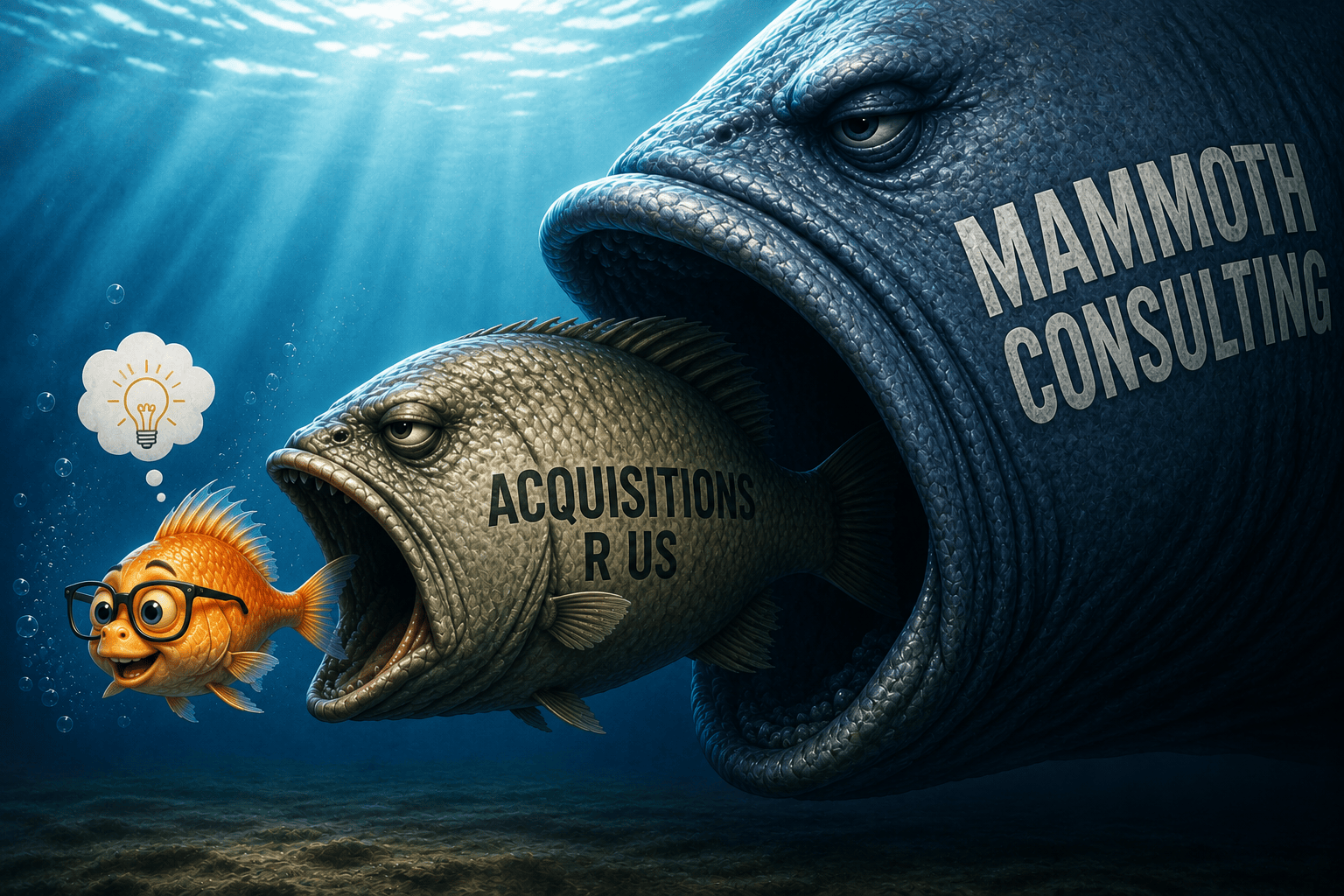
Reflecting on this, in my career I have experienced first-hand – as an employee of either an acquired or acquiring organization – ten boutique consulting firms go through acquisitions by larger companies. The pattern was nearly identical in every case: a small company started by passionate, visionary leaders, often on a shoestring budget; family members often running back-office operations to get business off the ground. Working hard, the business grew organically and they hired friends, family and former colleagues who were loyal and motivated. Employees appreciate their leaders’ transparency and personal commitment to their mutual success.
Then, a larger company came in and made an offer to buy the business, promising to leave operations and leadership intact. The founders wrestled with the decision but might have seen retirement in sight and took a midlevel management position in the new organization so they could continue to lead their team all the while seeing the inevitable culture shift and misalignment of corporate vision. Leaders learned to cautiously manage communication with the employees they led as to align the message with corporate rhetoric and executive leadership goals.
Acquisitions take place for a variety of reasons and on occasion may serve to strengthen or improve a company’s services. But in my experience, most IT consulting acquisitions take place for two reasons: to grow and increase profits of the acquiring company and their investors, and to give the founders of the smaller acquired company a lump sum cash-out. The net effect is always redundant leadership and negative impact to the company culture. It’s OK to work for a large organization and there are a few good ones that cultivate a positive work environment. The problem is when free-thinking individuals – particularly creative technologists – go to work for a small firm fueled by the freedom to problem-solve and collaborate are forced into the bureaucracy of a large corporation.
Corporate Growth as a Measure of Success
The percentage of book authors, conference presenters, active bloggers, content producers and Microsoft MVPs is considerably higher among consultants working for small firms. If you visit most big IT consulting company web sites, most articles about AI and tech innovations are not to serve the industry or provide thoughtful assistance, but to drive a marketing message and generate sales leads. We all need to make a living to pay the bills and keep the lights on, but some of us absolutely love working with data and genuinely want to support others in the community out of our sheer love of the craft.
I enjoy working in focused teams and I have gravitated toward the uncomplicated landscape of a smaller firm. Looking back on my career, I see a trend. Now, before I sound like I’m slinging mud at all big consulting companies, I want to be clear that there are a lot of great people who work for a lot of great companies throughout the technology consulting industry. There are good companies out there – large and small. There are also crappy companies who employ great people. This is my experience.
My Experience in Brief
In the mid 90s, I was recruited by a local consulting shop while doing independent development work at HP here in the Portland area. We were a tight-knit group of about 40 consultants who worked collaboratively to serve local companies like Intel, HP and Nike. The company founders were local tech guys from Intel who saw the opportunity to contract application deployment and data services to the companies they had worked for. At the height of the dot com wave, a bigger San Francisco based tech consulting company came in and made the owners an offer they couldn’t refuse. We lost our identity and team culture. Employees left one-by-one and the local company vanished into the ether.
I went to work for a small Business Intelligence consulting and training group called OLAP Train in Seattle as they were going through an acquisition. I had just published a book about SQL Server Reporting Services, and the skill was in high demand. After the Enron Energy audit coverup in 2000, Arthur Anderson was shut down by the federal government which prompted a fire sale of affiliated Anderson Consulting offices all over the country. Several of these practices were bought up by big holding companies like Hitachi – so the former Anderson Consulting office in Seattle and several other locations became Hitachi Consulting. Eventually our lean, mean little BI training and consulting practice became homogenized into the larger consulting portfolio. We did a lot of interesting work across different industries, and I learned a lot about managing projects – but I learned that big corporate consulting wasn’t where I thrived, so I went back to independent consulting and had consulting contracts both on my own and through reputable, data and BI-focused consultancies.
About eight years ago, while doing independent BI and data work, I was offered a fulltime position with one of the companies I was contracting for – a small, boutique data and BI consulting firm with about 60 employees. We were like a family, and I knew everyone I worked with. We were dedicated and would do anything to help our clients succeed. When I learned a year later that the owners had sold-out to a larger firm, I was disappointed but trusted our leaders to do the right thing – so I stayed on and slogged through no less than eight major practice-level leadership changes during my seven-year tenure at the “new-and-improved” company. Every new leader had a new vision and pitch deck. They used metaphors like rock bands, sports teams, pyramids and matrices to share their new vision and annual reorg plan. Every year, a new leader would come in to run the practice, play the same broken record, get burned-out and leave, to be replaced by another practice leader.
The acquiring company was founded by a couple of Microsoft sales execs who saw the opportunity to acquire several small consulting shops and, with the financial backing of an investment firm, take-over a big chunk of the IT consulting market in the US. Like the Borg in Star Trek, they systematically bought up and literally assimilated several specialized consulting shops and grew the company headcount from a couple hundred to well over a thousand before they put the company up for sale to an even larger international consulting firm with over 300,000 employees. We had no idea who was in charge or who to follow, so most employees went to their corner and kept their heads down.
People and Resources
Relationships are lasting. Assignments are short-term. One of the big differences between genuine client consulting and big-consulting project staffing is the idea that projects are staffed with “resources”. The “virtual workplace” has tremendous appeal and cost savings but companies that don’t compensate for the isolation and disconnection that goes along with remote work are only diluting the industry and business cultures. Remote work and offshore teams have great advantages in the industry, but we still need to connect with each other and will our customers.
In the process, we forget that “resources” are actually people – humans with aspirations, lives, goals, families. On the other hand, “resources” are line items on a profit and loss statement and a project plan. Companies and leaders who invest in the people by sending them to training classes, technical conferences, encouraging and incenting them to engage in community events; learn that they are valued humans and not just line items on a P&L ledger.
What Drives Consultants and Consulting Company Leaders?
A lifetime has taught me to distrust salesmen. I’m not saying that everyone who sells anything is a lying scumbag. I’m just saying that in my experience a large portion of the scumbag population are salesmen – along with a minor portion of respectable individuals. I know and respect some good, honest people who are in sales, but when every all-hands meeting sounds like a sales pitch, that “sell and persuade” culture promotes distrust and becomes part of the corporate DNA.
I left that company on good terms to accept a position with a very respectable specialized consulting firm who focus on the technologies and services that I love. Once again, it feels like family and my colleagues would take a bullet to serve our clients. I have had an amazing career as an IT data consultant. I love the work – solving puzzles, figuring things, creating solutions, and helping business customers find value with data. I’m not salty about my recent fish-eats-fish-eats-fish employment experience. Cynical? Maybe a little. I am happy to have had the experience. Now I recognize the cycle.
After 30 years of watching this cycle repeat in the IT consulting industry, here’s my conclusion: consulting companies come and go, but people who are smart and passionate about their craft are the real asset. It’s not about the sales pitch or the PowerPoint slide about company accolades — it’s about the people doing the work. Find out who the actual experts are, what motivates them, and whether they’re invested in your long-term success. Those are the people who’ll still be there when you need them.